
Maker History · 1772 – 1956
Wilkinson Sword: from the armoury to the shaving mirror
A London gunmaker of 1772 became Britain's sword maker, then sold the nation its razors, roller shavers, stropping machines and self-stropping Empire sets, all made from 'sword steel'.
Stropper.com archive · November 16, 2026
Few names in this archive carry as much weight as Wilkinson. For more than a century before it made a razor, the firm armed the British Army. When it turned to shaving, it sold every razor on one claim: these were blades of sword steel.
Guns, then swords
Henry Nock, a celebrated London gunmaker, opened his business in 1772. When he died in 1804 it passed to James Wilkinson, his former apprentice and son-in-law. James's son Henry moved the firm to Pall Mall, close to its biggest customer, the Board of Ordnance, and built it into the country's leading sword maker. In 1889 it was incorporated as the Wilkinson Sword Company, with a factory at the Oakley Works.
Into shaving
In the 1890s the range grew to thousands of products, cut-throat razors among them. In 1898 Wilkinson brought out its first safety razor. Within a few years it was advertising a Patent Safety Shaver with an anti-friction roller: instead of a guard, a small roller ran over the face and fed the lather onto the edge.
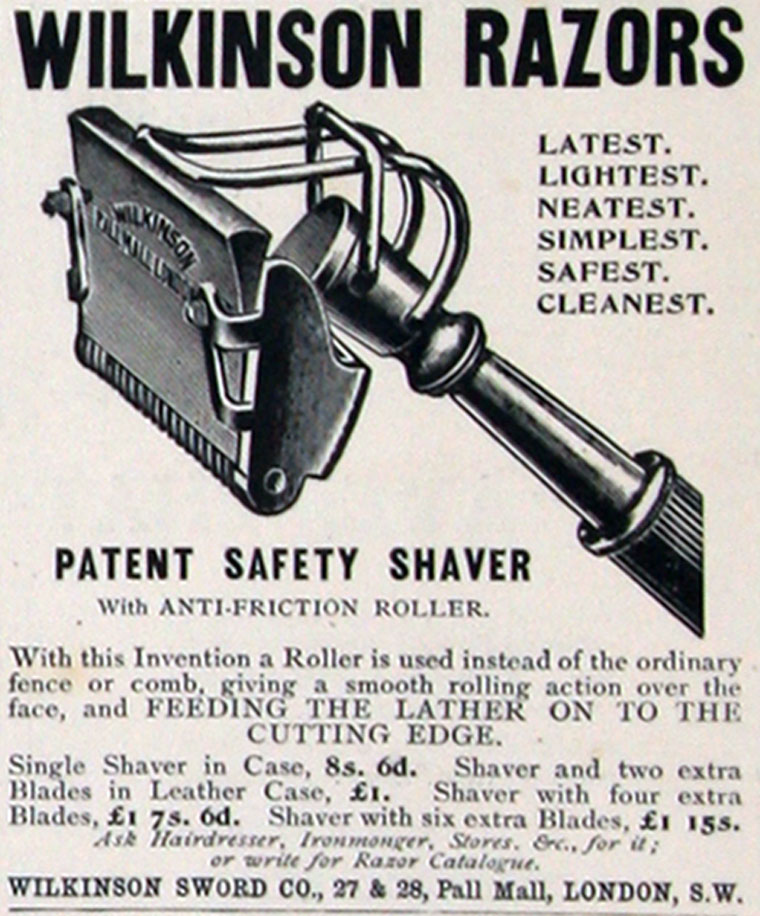
The archive's earliest Wilkinson sets, Wilkinson 6b and Wilkinson 7, carry the Pall Mall address of those first years. Wilkinson 6b is dated to 1903 from Henry Wilkinson Latham's patent of 1902.
Stropping machines
A safety-razor blade dulled quickly, and Wilkinson's answer was the stropping machine: a frame that held the blade against a moving strop. A 1905 British patent for improvements in razor-stropping machines is recorded on Wilkinson 4, a pull-handle machine. By 1921 Wilkinson's trade advertising listed three lines side by side: sword-steel razors, the "1920" model safety shaver, and double-action stropping machines.
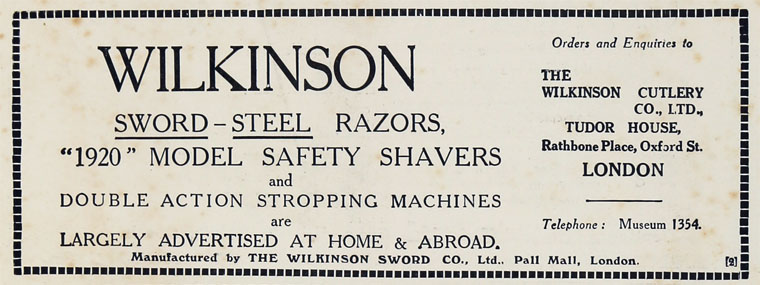
The collection includes Wilkinson 9a, rarity 8, marked with a 1919 razor patent, and the double-edge strop machines Wilkinson DE Stropper 1 and 2, marked Pall Mall and Oakley Works, Acton Green.
The Empire and the self-stropping razor
In October 1929 Wilkinson patented a safety razor whose blade could be stropped without being taken out, a British answer to the Valet AutoStrop. It was sold as the Empire model and was made until 1952. Most of the Wilkinson pieces in this archive carry that patent, GB 321,115. Others carry Enderby Latham's patent for an adjustable guard. The American sets name Alfred Dunhill of London, Inc., 614 Fifth Avenue, New York as exclusive agents, and Wilkinson Baker was distributed in Sydney.
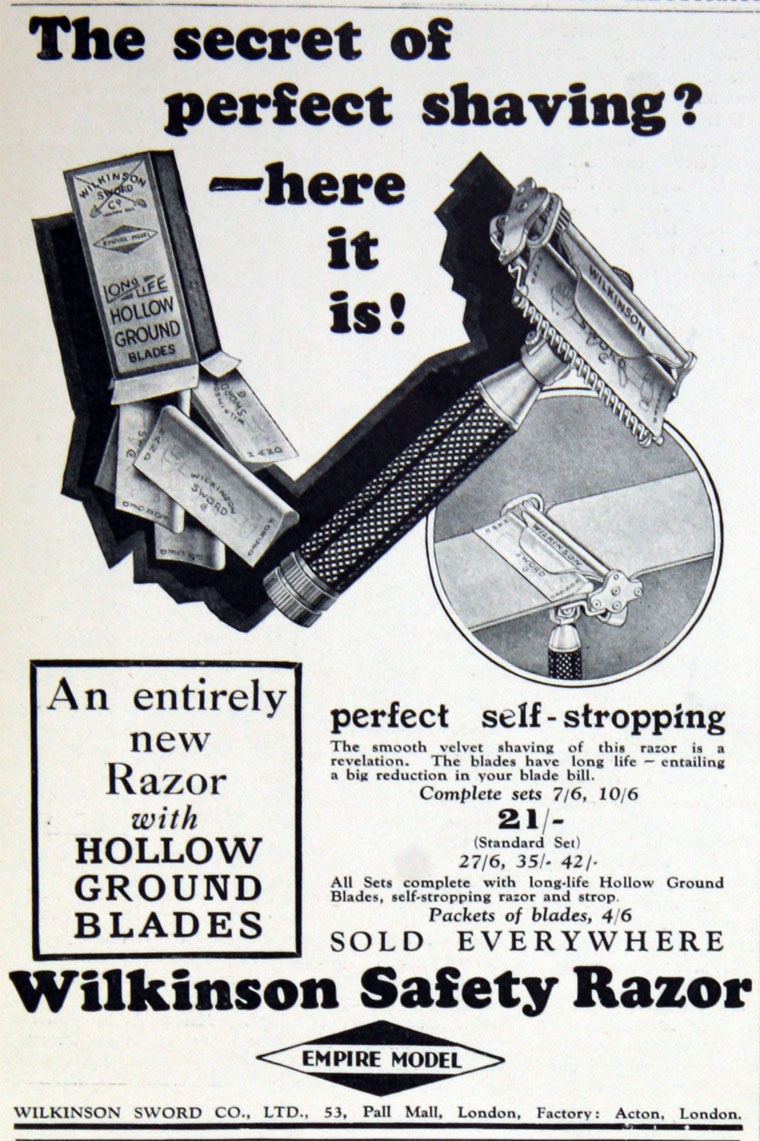
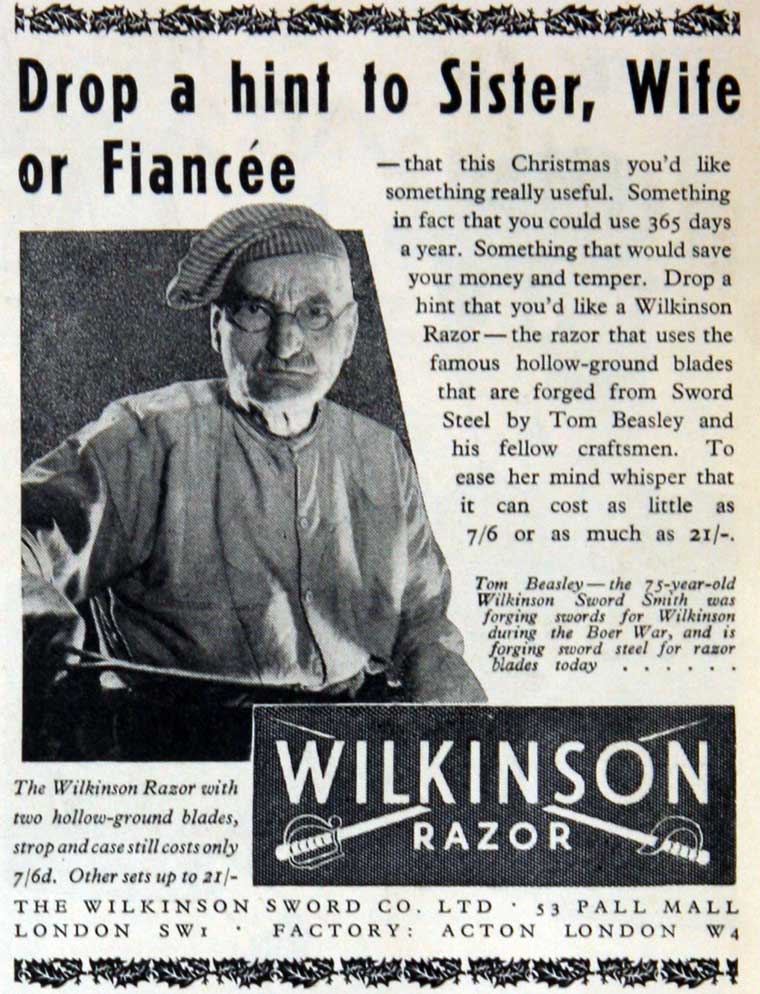
By the 1930s the advertising had a face: Tom Beasley, a sword smith who had forged blades during the Boer War and was now forging sword steel for razors.
After the war
During the Second World War Wilkinson made commando knives, aircraft fittings and flak jackets. Razor production resumed afterwards, and in 1956 the company launched a stainless-steel blade. Stainless blades lasted far longer than carbon ones and made stropping unnecessary. The razor Wilkinson made famous helped end the era of the strop.
See all 54 Wilkinson pieces on the maker page, and seven Wilkinson ads in Period Advertising.
Sources
- Grace's Guide to British Industrial History, Wilkinson Sword
- Encyclopedia.com, Wilkinson Sword Ltd.
- Science Museum Group, Wilkinson cased safety razor set with stropping machine, c. 1900
- College of Charleston / Charleston Museum, Wilkinson Empire 7-Day set (Empire series made until 1952)
- Patents recorded on the Wilkinson pieces in the Stropper.com collection (GB 1905/16,595; GB 156,323; GB 235,024; GB 321,115; GB 398,901; GB 558,703)