

Maker History · 1909 – 1959
Twinplex: the crank that kept a blade alive
How a 1910 patent from a small Illinois town became the best-known blade stropper in America, and why the company that made it still exists.
Stropper.com archive · November 13, 2026
When the disposable safety-razor blade arrived in the early 1900s, it came with a catch. Blades were costly, and a dull one went in the bin. That opened a market for gadgets that promised to bring a blade back to life. Of the dozens of stroppers that followed, few lasted as long, or survive in such numbers today, as the Twinplex.
A patent from Granite, Illinois
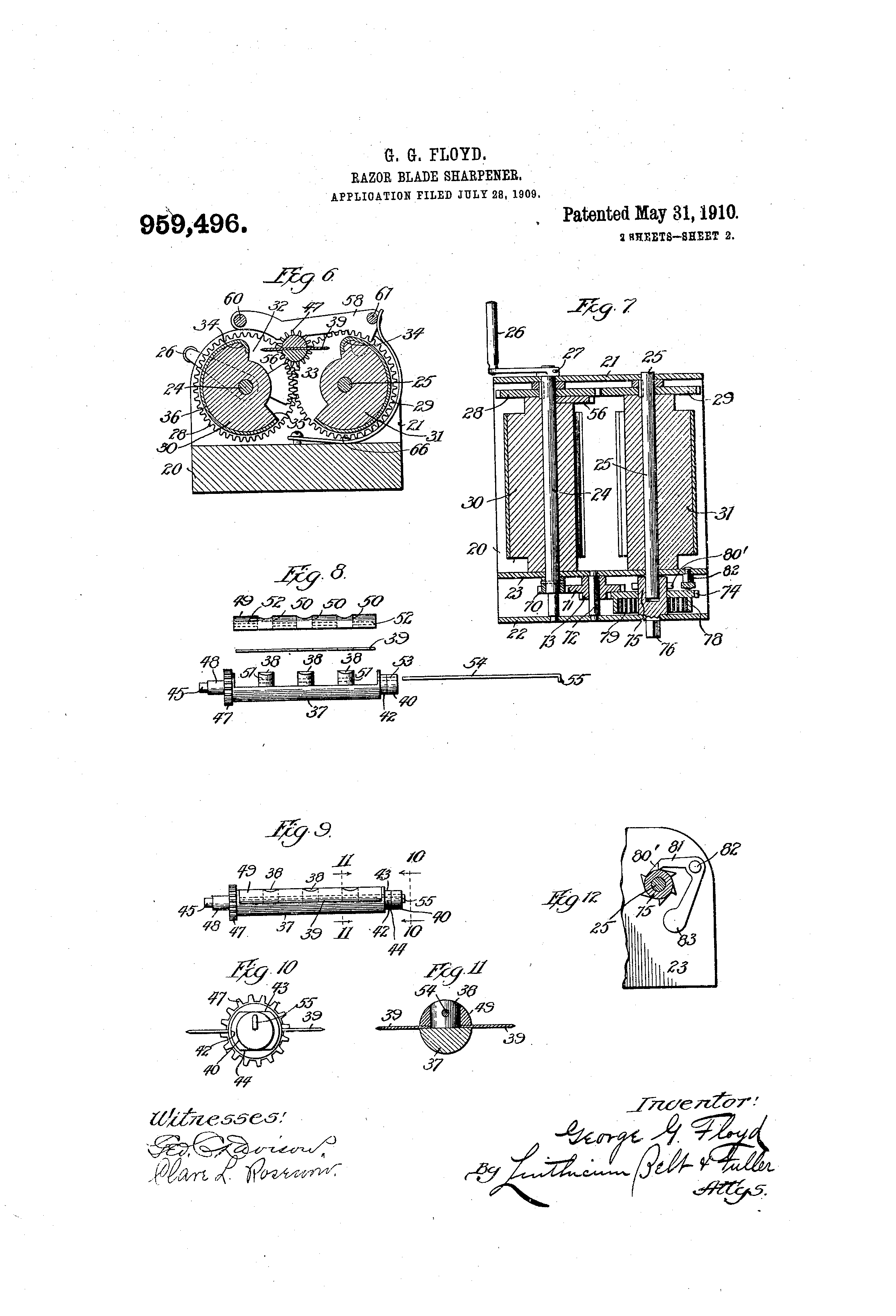
On July 28, 1909, George G. Floyd of Granite, Illinois, a steel town across the Mississippi from St. Louis, filed a patent for a "razor-blade sharpener." It was granted on May 31, 1910 as U.S. Patent 959,496 and assigned to the Twinplex Manufacturing Company of St. Louis, a Missouri corporation.
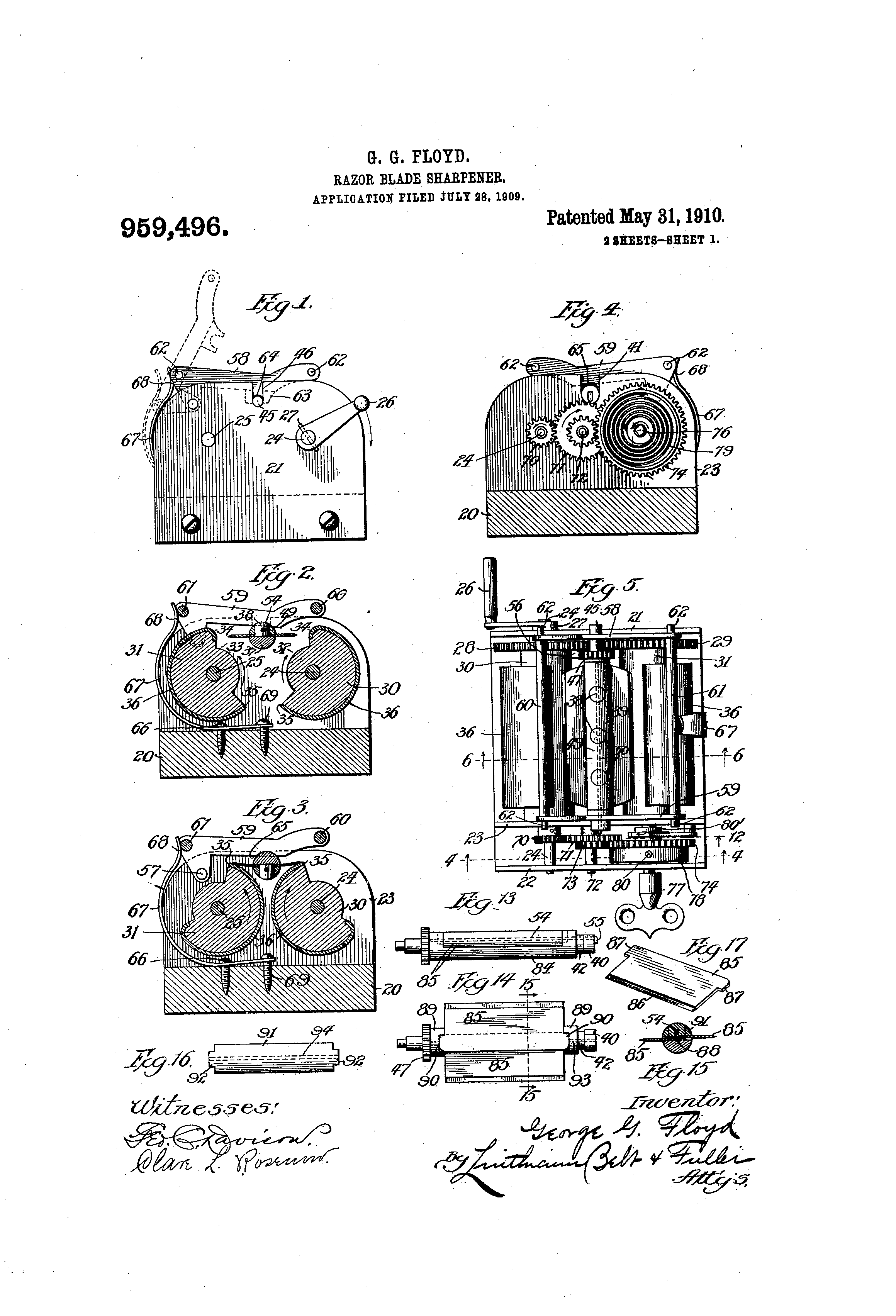
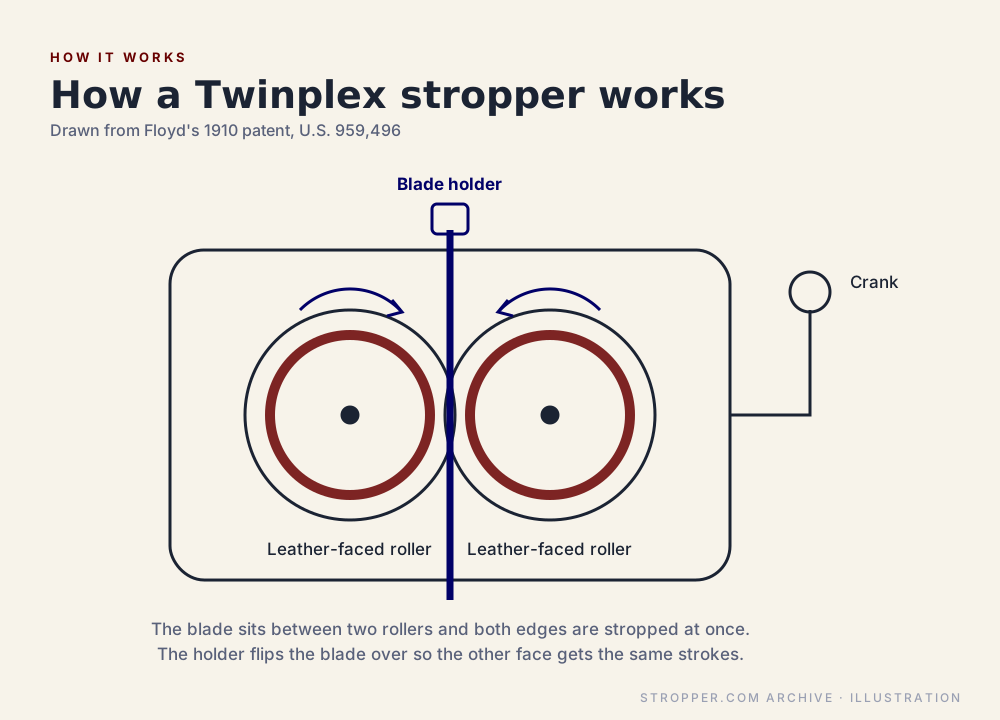
The idea was simple to use and clever inside. A blade went into a holder between two rollers covered in leather. Turning a crank spun the rollers against both edges at once. Then the mechanism flipped the blade so the other face got the same treatment. The drawings show the gear train that made that happen.
"Just turn the crank"
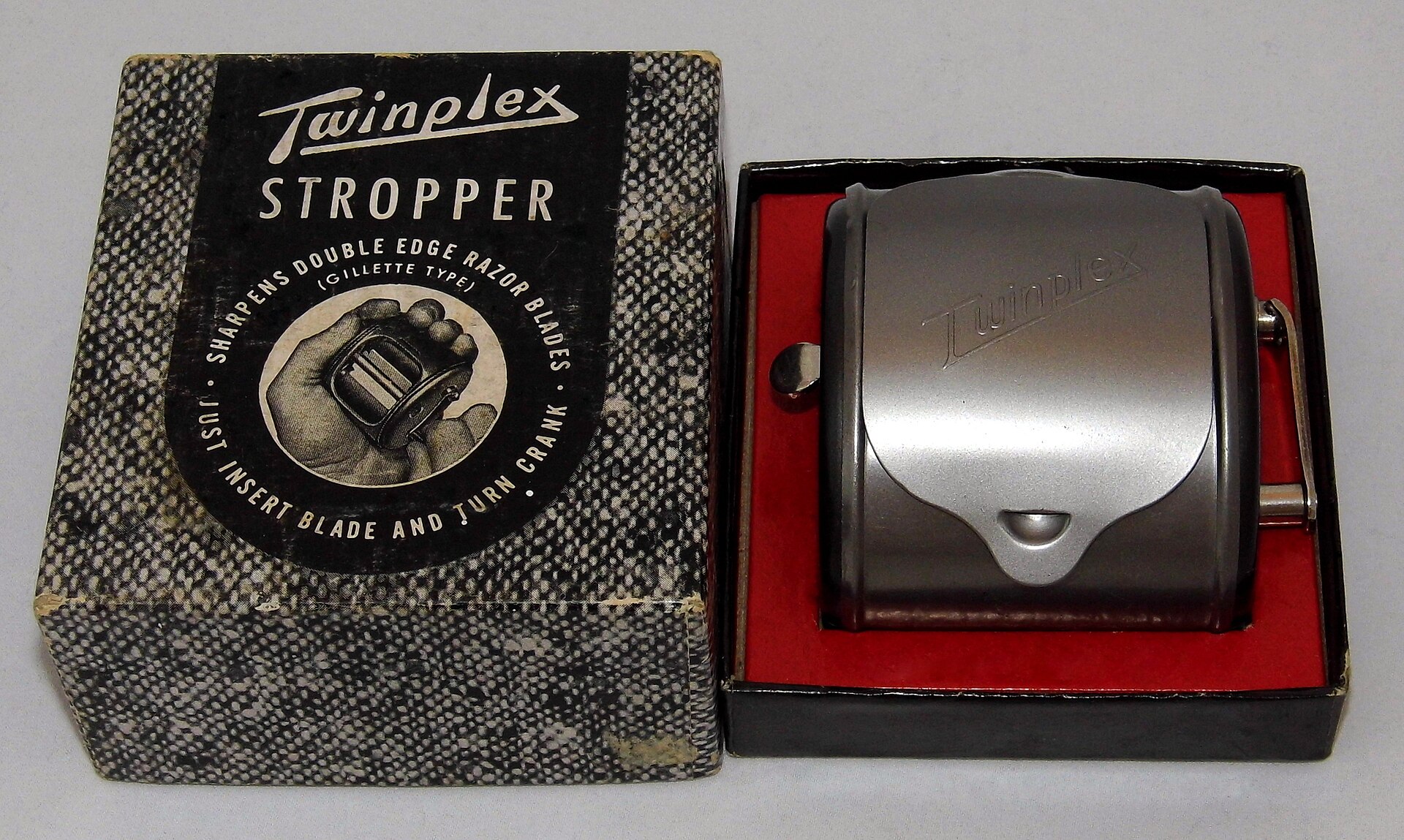
By the First World War, Twinplex was advertising across the country. A January 1918 newspaper ad told shoppers that every soldier should have a Twinplex stropper. It explained that the machine stropped both edges at once, reversed the blade and did the other side. Drugstores paired it with Gillette razors as a gift set. Owners kept the boxed instructions, and one surviving set gives the maker as the Twinplex Sales Co. of St. Louis, with patent dates from 1915 to 1920 and an original price of $5.
That name fits this archive. Most of the earlier Twinplex pieces in the collection are marked Twinplex Sales Co., St. Louis, MO, and a few read Twinplex Manufacturing Company, St. Louis. In the 1920s Twinplex built models made for Gillette blades, while its rivals courted owners of other razors.
The move to Chicago
Later Twinplex stroppers read differently. Pieces in the collection carry Twinplex Manufacturing Co., Chicago 13, IL and Twinplex Products Co., Chicago. One, the TwinStrop, also names TX Mfg. Co., 1800 Roscoe St. The Made in Chicago Museum places the factory at 1800 W. Roscoe Street. A Canadian museum dates a grey two-roller Model G200 made in Chicago to 1935.
Incorporated in 1941, and still in business
According to the company's own profile, Twinplex incorporated in 1941 and is still run by the same family. Its first product was Floyd's stropper. Over the years it also sold razors, brushes, blades and shaving cream under the Twinplex name. As blades got cheaper and better, stropper sales fell, and the company made its last stroppers in the late 1950s. It then turned fully to contract metal stamping. Today it does custom deep-drawn stampings in Wood Dale, Illinois.
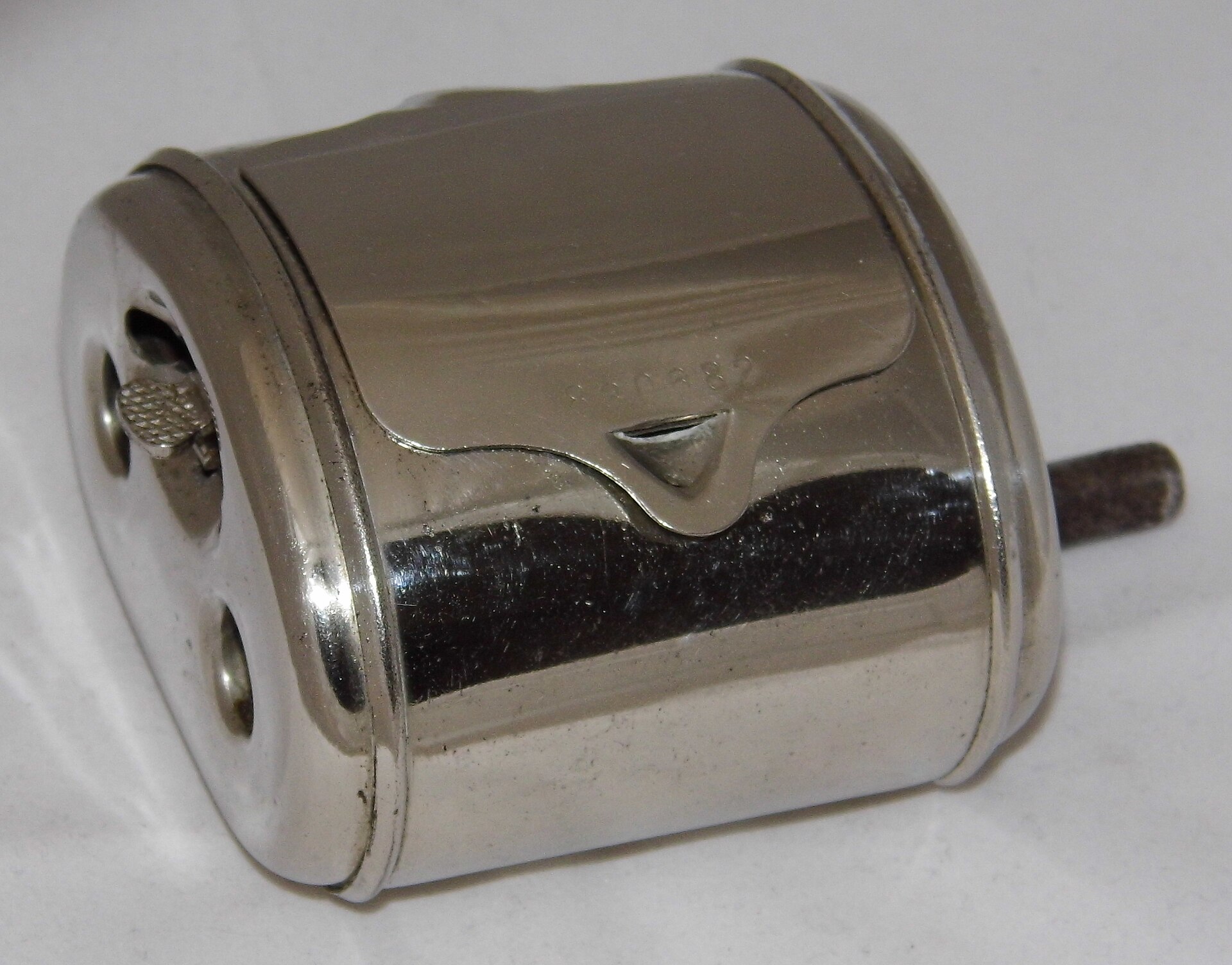
What we still don't know
The company profile says stroppers were made from 1905, but Floyd didn't file his patent until 1909. Until a pre-1909 Twinplex turns up, 1905 is best treated as unverified. A collector wiki gives separate dates for the Manufacturing Co. (1910–11) and the Sales Co. (1911–29), a Chicago branch by 1916 and a Collier's advertisement of October 18, 1924. These are useful leads, but none has been checked against the original documents yet. Because the company is still family-run, its own files may hold the answers.
See every Twinplex piece in the archive on the maker page.
Sources
- U.S. Patent 959,496, G. G. Floyd, Razor-blade sharpener (filed July 28, 1909; granted May 31, 1910)
- El Paso Herald, Jan. 18, 1918, Twinplex advertisement (Library of Congress)
- Kovels, Twinplex Stropper (Twinplex Sales Co. paperwork, $5)
- Lake County Historical Society, Stropone razor sharpener
- Made in Chicago Museum
- Saskatchewan collections, Twinplex Model G200 (1935)
- Twinplex company profile