
Maker History · 1916 – 1964
Rolls Razor: the case that sharpened the blade
A British safety razor with one blade meant to last for years, honed and stropped inside its own case. Then the company that made it became the vehicle for a 1960s washing-machine boom and bust.
Stropper.com archive · November 14, 2026
Most blade sharpeners in this archive are something you bought after the razor, to rescue a dull blade. The Rolls Razor turned that around. The sharpener was the razor's home. You bought one hollow-ground blade, kept it in a case with a hone in one lid and a strop in the other, and expected to shave with it for years.
The inventor
The idea belongs to Helier Alexandre Vincent, who was born in Jersey and was working as a company director in London before the First World War. His British patent, No. 108,531, for a safety razor and a device to sharpen it, was applied for in August 1916 and accepted the following year. A matching U.S. patent, 1,266,183, followed in May 1918. The earliest sets in this collection carry both numbers, along with a French patent from 1918.
The company that made the razor was set up around 1921. Sources disagree on the exact year: one says about 1920, another 1921, and the trademark's claimed first use is 1922. The name was borrowed for its sound. Rolls Razor had nothing to do with Rolls-Royce, but "Rolls" already meant the best money could buy.
How it worked
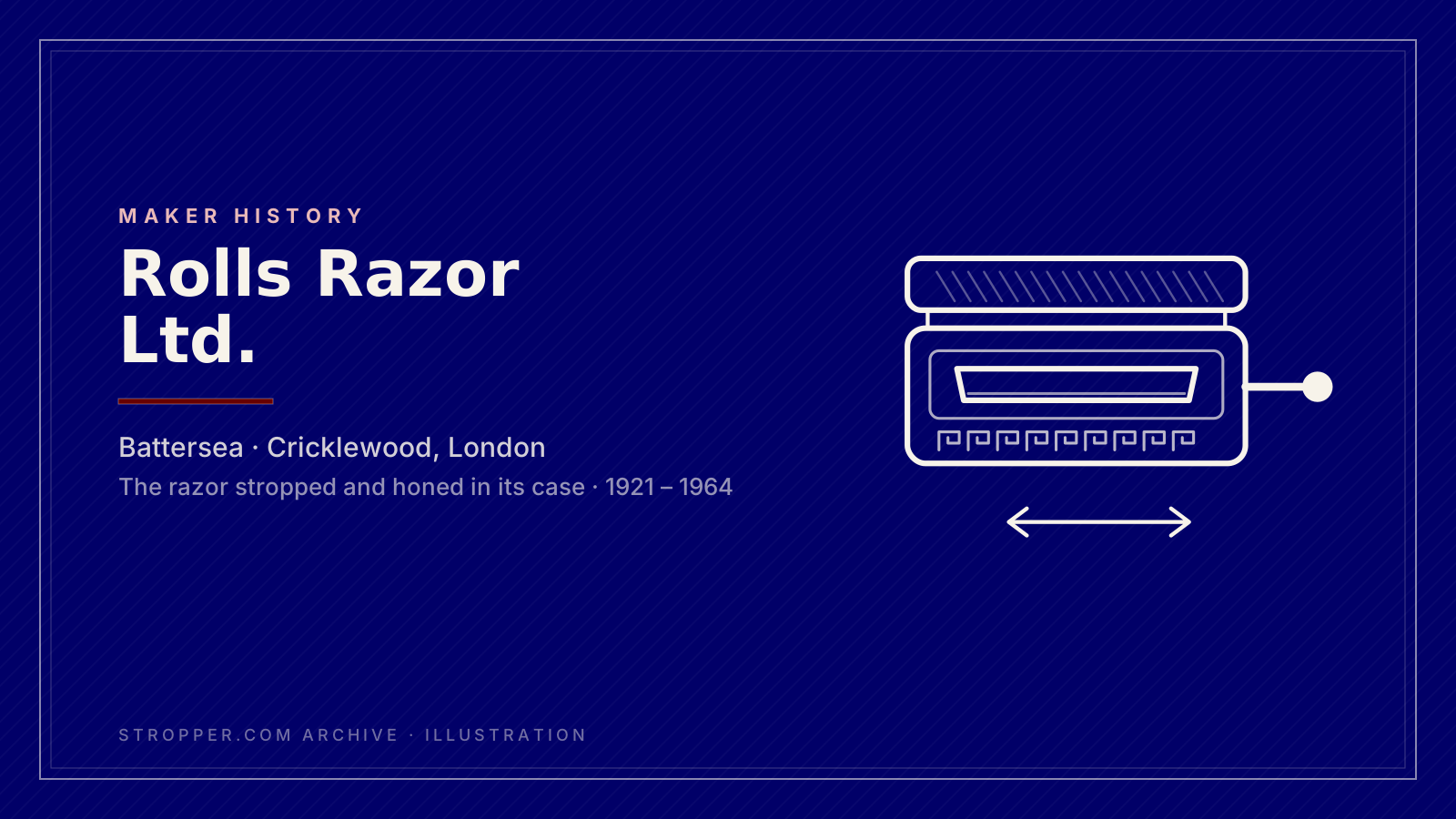
The razor lived in a flat metal case about six inches long. Lift off one lid and you found a grey honing stone; turn the case over and the other lid carried a leather strop. The two lids were not interchangeable, because a blade has to be pushed edge-first into a hone but drawn spine-first across leather.
To sharpen, you clipped the blade into the case and worked a handle back and forth. A shaft with small pinions ran along racks in the case, sliding the blade over the stone or the strop and flipping it at each end. It was quick and noisy, and it worked. Then you fixed the same blade to a short handle and shaved. Nothing was thrown away.
The company's trademark showed exactly that: a kneeling man honing a blade, known as The Whetter.
Battersea, then Cricklewood
The first address was grand. Our Rolls First Model is marked Head Office, 1 Charing Cross, Trafalgar Square, London S.W.1; Works, Ingate Place, Battersea, S.W.8. The pebble-finish "Popular" cases from those early years carry the Charing Cross address too.
In July 1926 the firm bought a much bigger site on Cricklewood Broadway in north-west London for £17,500. The building had been put up for a coachbuilder and then used by British Caudron to build military aircraft, Sopwith Camels among them, during the First World War. In October 1927 the business was refloated with £200,000 of shares as Rolls Razor (1927) Ltd. The name became plain Rolls Razor Ltd. in 1929, and Cricklewood, London N.W.2 appears on most of the pieces in this collection.
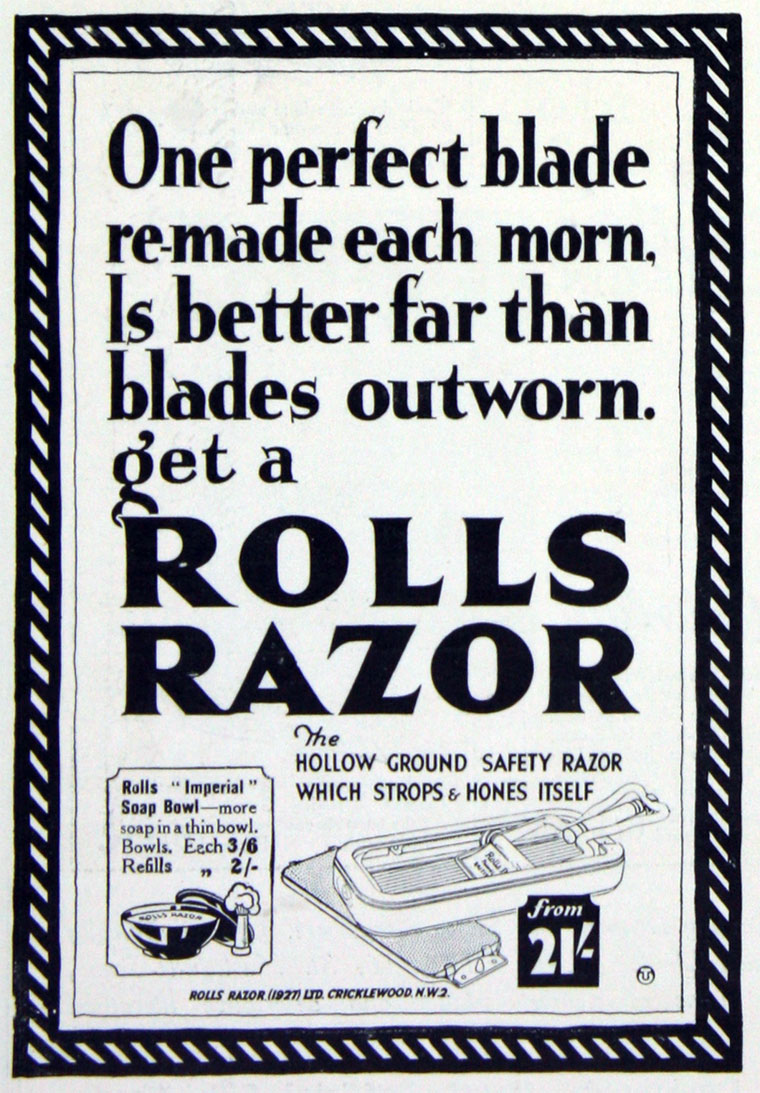
That 1928 Christmas advertisement sums up the pitch in rhyme: one perfect blade remade each morning beats a pile of worn-out ones. Sets started at 21 shillings, and the firm sold matching soap bowls and refills to go with them.
Across the Empire and America
The markings on these razors trace the export trade. American sets name the importer Lee & Schiffer, 305 East 45th Street, New York, and later Rolls Razor, Inc. at 342 and then 338 Madison Avenue. Canadian sets name Rigo Agencies of Toronto and Montreal and F. J. Bossons Ltd. of Vancouver. Newspapers in New Zealand were advertising the "New Imperial" model at 40 shillings in 1930, sold through tobacconists.
Collectors date sets by their decoration. Cases made before about 1930 lack the Greek-key border that later became the Rolls signature. The boxy Imperial, most often in nickel plate, was the workhorse. The rounder Viscount came later, and wartime cases were made of aluminium. A Rolls in a presentation box was the classic present for a young man's 21st birthday.
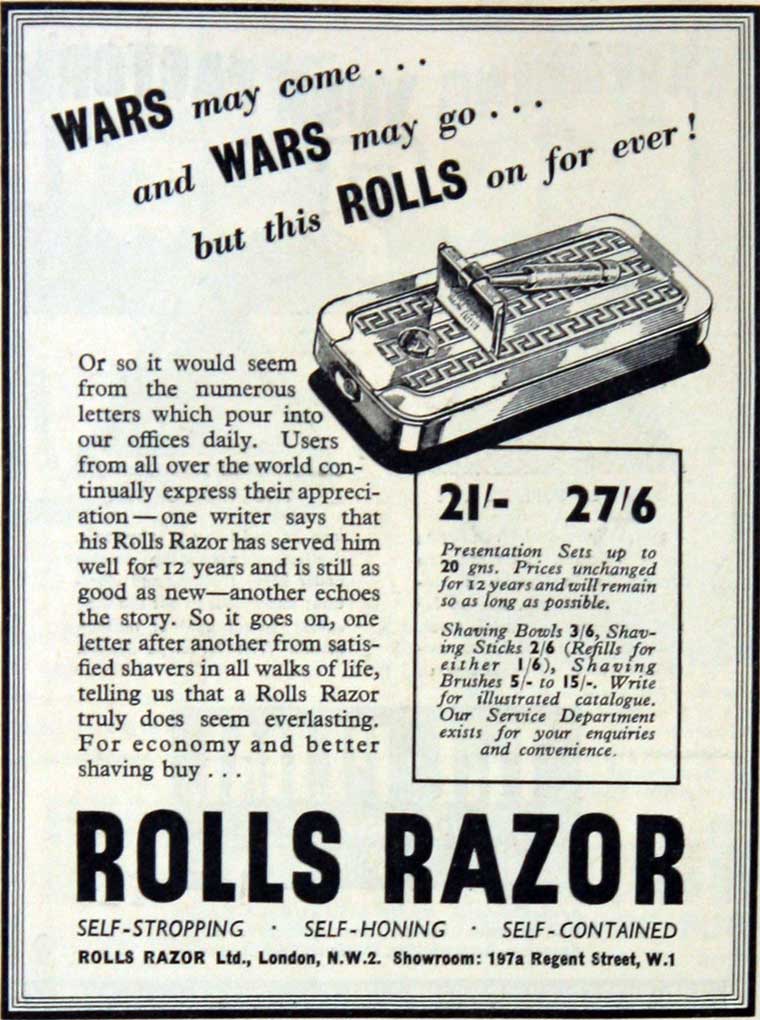
By the late 1930s the advertising leaned on owners' letters. One ad quotes a reader whose razor had served him for twelve years; a 1938 series ran testimonials under the banner "These views make news for shavers." The prices barely moved: 21 shillings to 27s 6d, with presentation sets up to 20 guineas.
Viceroy and the end of the blade
In 1937 Rolls applied for a patent on a hand-powered dry shaver: you pressed a lever and the cutters moved. It became the Viceroy, and after the war came electric Viceroys, made for a time at a new factory in Hemel Hempstead that opened in 1952.
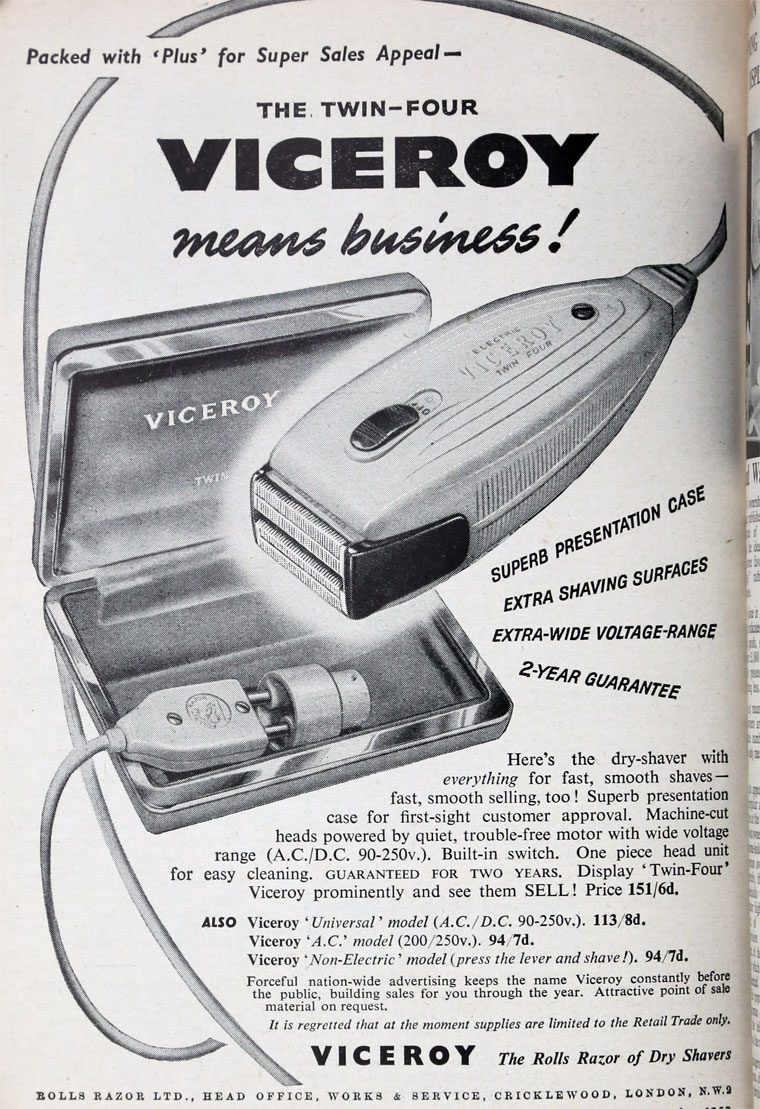
Electric shavers were the future, but they were not enough to save the company. Losses mounted through the 1950s. Sources disagree on exactly when the self-stropping razor stopped being made; one puts the end at 1958.
The washing-machine years
Around 1960 the business was taken over by John Bloom, a young salesman who sold twin-tub washing machines by mail at roughly half the price of the big brands. Rolls Razor became his manufacturing company, building the Rolls Rapide at Cricklewood. For a while it was a sensation, one of Britain's biggest washing-machine makers, until a price war, rising costs and the loss of its financial backer brought it down. In July 1964 Rolls Razor went into voluntary liquidation owing millions, which led to questions in the House of Commons. The collapse also produced a landmark court case, Barclays Bank v Quistclose Investments (1968), still taught in English law schools.
In the collection
The archive holds 79 Rolls pieces, one of the deepest runs of any maker. Highlights:
- Rolls First Model, from the Charing Cross and Battersea years, rarity 8.
- Rolls Demo Machine, a Cricklewood shop demonstrator and the most valuable Rolls piece in the archive.
- Rolls Popular 1, an early pebble-finish case.
- Rolls Razor Spare Parts Kit and the Rolls Shaving Mirror, patented in 1940.
- Rolls Viscount Coronation, a one-off variant.
See every Rolls piece on the maker page, and more Rolls advertising in Period Advertising.
Sources
- Grace's Guide to British Industrial History, Rolls Razor
- Kilburn & West Hampstead history blog, The Rolls Razor factory in Cricklewood (2023)
- Rolls Razor — Wikipedia (via Wikiwand)
- Electric Shaver Museum, Rolls Razor exhibition
- Science Museum Group, Rolls Razor Limited 1922–1964
- Papers Past, NZ Truth, Feb. 13, 1930, p. 15 (Rolls 'New Imperial' advertisement)
- Markings on the 79 Rolls pieces in the Stropper.com collection